
Why Do I Push People Away When Someone Gets Close?
Pushing people away as a relationship deepens is usually a protective response the nervous system learned long ago, not a flaw or a sign you don't care. For many people it traces back to early relationships where closeness came bundled with unpredictability or loss. The system learned to treat needing someone as a risk to manage in advance.
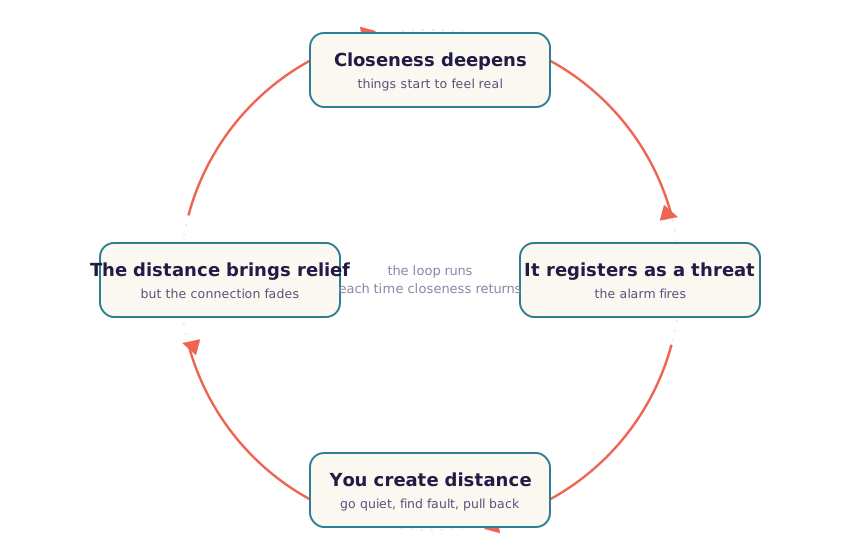
If you have ever ended something that was going well, or felt a sudden urge to create distance right when a relationship started to feel real, you are not unusual and you are not broken. This is one of the most common patterns people bring to therapy, and it has a fairly well-mapped logic behind it. This article walks through what the pattern tends to look like, where it comes from, and why it so often feels like a reasonable choice in the moment even when it works against what you actually want.
The distancing usually starts before anything goes wrong
Here is the detail that catches most people off guard. The urge to pull away rarely shows up because your partner did something wrong. It shows up because things got good.
A relationship reaches the point where it would genuinely hurt to lose it, and something quiet shifts. You start noticing flaws you hadn't seen. You get busy. A text sits unanswered a little longer than it needs to. Some people manufacture a small conflict without quite realizing that's what they're doing. Others just feel a flat, restless dissatisfaction with a person who, two weeks earlier, felt like a good thing.
The protection tends to arrive before there is anything to protect against. The wall goes up before anyone has tried to climb it. That timing is the clue, and it points to something older than the current relationship.
What pushing people away actually looks like
The pattern wears a lot of different clothes, and part of what makes it hard to catch is that each version comes with a story that sounds reasonable from the inside. A few of the common shapes:
Going quiet when a conversation gets emotionally intense, and calling it needing space. Keeping one foot out the door in every relationship, staying a little unavailable so that no single person's absence could level you. Finding fault at the exact moment things deepen, and experiencing that fault-finding as having high standards rather than as a retreat. Filling your calendar so full that intimacy never gets room to build. Ending things for reasons that, examined later, don't fully hold up.
None of these feel like fear in the moment. They feel like clarity and self-respect, like the plain sense of knowing what you want. And you may not be entirely wrong about any given instance. Sometimes a relationship really isn't right. The tell is the pattern: when the withdrawal shows up reliably at the same depth, relationship after relationship, something more structural is running underneath the individual reasons.
Where the pattern comes from
Attachment theory, first developed by John Bowlby and extended through decades of research by Mary Ainsworth and later Mario Mikulincer and Phillip Shaver, offers the clearest framework here. The short version: as children, we learn a template for what closeness costs and whether people can be relied on. That template doesn't disappear when we grow up. It becomes the automatic setting for how we handle intimacy.
If the people who were supposed to be a source of safety were sometimes unavailable, overwhelming, or hard to predict, the nervous system adapts. One of the most common adaptations researchers describe is a set of deactivating strategies: ways of turning down the volume on the need for closeness so that it can't leave you exposed. Self-reliance becomes the safest bet. Depending on someone starts to feel less like comfort and more like exposure.
This is worth saying plainly, because a lot of people carry shame about it: the strategy made sense where it started. A child in an unpredictable home who learns not to need too much is doing something intelligent. The trouble is that the same strategy, running on autopilot twenty or thirty years later with someone who is actually safe, quietly pushes away the very closeness you are now trying to build.
Why it feels like a choice when it isn't
When a partner moves toward you emotionally and you feel that pull to retreat, a fair amount of it is happening in your body before it reaches conscious thought. Researchers who study this describe a physiological response to intimacy that, in people with this pattern, can resemble a mild threat response. The reaction can outrun the deliberation.
So by the time your thinking mind gets involved, it isn't choosing to withdraw so much as explaining a withdrawal that already began. And it tends to explain it in flattering terms, because "I have standards" is easier to sit with than "I'm scared of how much this matters." The reasons feel true, and they are also, more accurately, the story built around a reflex.
Wanting closeness and bracing against it at once: one hand reaching out while the other holds back
Drop file at: /assets/blog/why-do-i-push-people-away/reaching-and-bracing.svg
Pushing people away is not the same as not wanting closeness
This is the part people most need to hear, and the one they least believe about themselves. Wanting distance and wanting connection are not opposites here. They run at the same time.
Many people caught in this pattern want closeness badly. They just also carry a deep, often unspoken conviction that closeness is dangerous, so they end up living with one foot on the accelerator and one on the brake, reaching for connection and bracing against it in the same breath. The distancing isn't evidence that you are better off alone or that you don't have it in you to love someone. Often it is evidence of the opposite: the stakes feel high precisely because the wanting is real.
Can this pattern actually change?
Yes, and the research here is more encouraging than most people expect. Attachment patterns are not a fixed personality type or a life sentence. Longitudinal work by Glenn Roisman and colleagues describes what is called earned security: adults who grew up with insecure early histories but develop attachment functioning comparable to people who were secure all along. The nervous system is not permanently set by early experience.
That said, and this matters, the goal is not to force yourself into becoming a different person through sheer effort. Willpower tends to be a poor tool against a nervous system reflex. What actually tends to move the pattern is first seeing it clearly: recognizing the specific shape it takes for you, the moments it tends to fire, and the story you reach for when it does. You cannot interrupt something you cannot yet see. Understanding the mechanism is what gives you a real choice where there used to be only the reflex.
Seeing your specific version of the pattern
"Pushing people away" is a broad description, and the truth is that it plays out differently depending on the attachment pattern underneath it. For some people the distance is cold and quiet. For others it is tangled up with anxiety and comes out as testing, or as pulling close and pushing away inside the same week. The reflex looks similar from outside; the machinery underneath is not identical, and the thing that shifts it depends on which version you are running.
If you want to see the specific pattern behind your own distancing, the free attachment test maps exactly that: where your particular version comes from, what sets it off, and where it sits on the two dimensions that underlie every attachment style. It takes a few minutes, it is not a diagnosis, and it draws on the same research as this article.